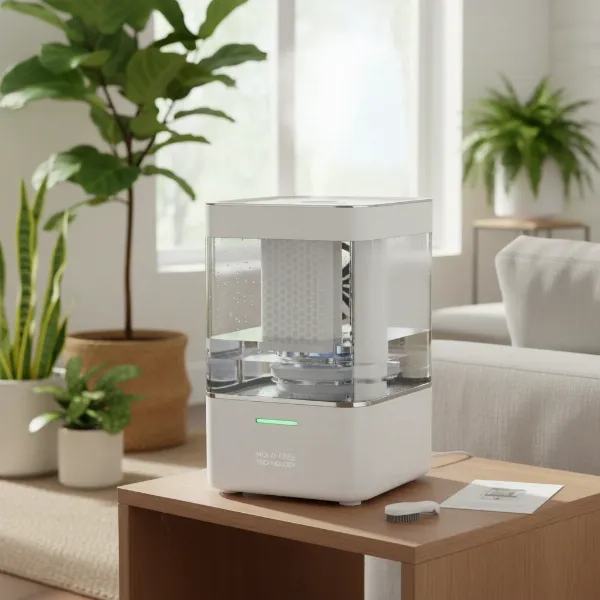
Creating the perfect microclimate is the secret to unlocking exceptional growth and bountiful yields in both indoor plant cultivation and mushroom farming. Without precise humidity control, your efforts can easily go awry, leading to stunted plants, dehydrated mushrooms, or even destructive mold. A high-quality humidifier isn’t just an accessory; it’s a foundational tool that can transform your indoor gardening success.
Whether you’re nurturing delicate seedlings in a grow tent or coaxing vibrant flushes from mushroom blocks, understanding and maintaining optimal humidity levels is paramount. This guide will delve into why humidifiers are essential, explore the different types available, help you choose the right one for your setup, and provide expert tips for seamless operation and maintenance. Let’s cultivate success, starting with the air your crops breathe.
The Indispensable Role of Humidifiers in Indoor Growing
Why is humidity such a critical factor for plants and mushrooms? It all boils down to how these organisms interact with their environment and manage their internal water balance. Just like humans, plants and fungi need specific atmospheric conditions to thrive.
For plants, proper humidity directly influences transpiration, the process by which plants release water vapor through their leaves. This transpiration acts like an engine, drawing water and nutrients up from the roots. If the air is too dry, plants transpire too rapidly, leading to stress, wilting, and reduced nutrient uptake, ultimately stunting growth and impacting overall plant health. Conversely, ideal humidity allows for efficient nutrient transport and robust development. Different growth stages demand varying humidity: seedlings and clones thrive in higher humidity (70-80% RH) to promote root development, while vegetative growth prefers 50-70% RH, and flowering plants require a drier 40-50% RH to prevent issues like powdery mildew and bud rot.
Mushrooms, which are roughly 90-95% water, are even more sensitive to ambient humidity. They lack a protective skin, making them highly susceptible to drying out. Consistent high humidity, typically between 85-95% RH, is crucial for initiating pinning (the formation of tiny mushroom primordia) and for the full development of fruiting bodies. Without sufficient moisture, mushroom pins can abort, caps can crack, and yields will be significantly reduced. Too much humidity, however, can encourage pathogenic mold and bacterial growth, compromising the entire crop.
Using a humidifier mitigates these risks, ensuring your plants and mushrooms receive the consistent atmospheric moisture they need at every critical stage, leading to healthier growth, stronger defenses, and more abundant harvests.
Navigating the Types of Humidifiers for Your Cultivation Space
When it comes to introducing moisture into your grow tent or mushroom fruiting chamber, not all humidifiers are created equal. The two primary types you’ll encounter are ultrasonic and evaporative humidifiers, each with distinct advantages and considerations.
Ultrasonic Humidifiers: Quiet Efficiency
|
Our Picks for the Best Humidifier in 2026
As an Amazon Associate I earn from qualifying purchases.
|
||
| Num | Product | Action |
|---|---|---|
| 1 | COO Humidifiers for Bedroom, 2L Tank for Large Room, 30 Hour Runtime, 28dB Quiet Cool Mist Humidifier for Home, Baby Nursery, Plants, Indoor, Office, Easy to Fill & Clean,Night Light and Auto Shut-off |

|
| 2 | Homvana Humidifiers for Bedroom Home, 3.6 L Cool Mist Top-Fill 34H Super Long Time, Quiet 23dB, Baby Humidifier, Oil Diffuser for Large Room, House, Plant, Nursery, Office, BPA FREE, Ultrasonic (Grey) |
|
| 3 | LEVOIT Humidifiers for Bedroom Large Room Home, (6L) Cool Mist Top Fill Essential Oil Diffuser for Baby & Plants, Smart App & Voice Control, Rapid Humidification & Auto Mode - Quiet Sleep Mode, Gray |
|
| 4 | MegaWise Topfill 7-colour Night light humidifier for Kid bedroom with 3.5L Large Capacity, No leakage Design Fine Mist Output Auto Shutoff, Essential Oil Safe Tank |
|
| 5 | LEVOIT Top Fill Humidifiers for Bedroom, 2.5L Tank for Large Room, Easy to Fill & Clean, 28dB Quiet Cool Mist Air Humidifier for Home Baby Nursery & Plants, Auto Shut-off for Safety, 25H |
|
| 6 | Dreo Humidifiers for Bedroom, 4L Top Fill for Large Room, 36H Runtime, 28 dB Quiet Supersized Cool Mist Air Humidifier for Baby Nursery, Plants, Indoor, Night Light, Easy to Clean & Fill, White |
|
| 7 | LEVOIT - Humidifiers for Bedroom - Quiet (3L Water Tank) - Cool Mist/Top Fill/Essential Oil Diffuser/25Watt - Home/Large Room - 360° Nozzle - Rapid Ultrasonic Humidification for Baby Nursery/Plant |
|
| 8 | DREO Humidifiers for Bedroom, 3L Top Fill 30H & 26dB Quiet Runtime for Large Room, Cool Mist Ultrasonic Humidifier with Humidity Sensor, Night Light for Home, Baby, Nursery, Plants, New Edition |
|
| 9 | DREO 6L Top Fill Humidifiers for Bedroom, 60H Runtime 28 dB Quiet Supersized Cool Mist Air Humidifiers for Large Room, Baby Nursery, Plant, Indoor, Night Light, Easy to Clean, Precise Humidity Control |
|
| 10 | Dreo Smart Humidifiers for Bedroom, Top Fill 4L Supersized Humidifier Large Room with 28 dB, 36H Runtime, Touch/APP/Voice Control, Nightlight, Cool Mist Humidifiers for Baby, Plants, Indoor, Black |
|
Ultrasonic humidifiers use a high-frequency vibrating diaphragm to turn water into a fine, cool mist. This technology is incredibly popular among indoor growers for several compelling reasons. They operate with remarkable quietness, a significant advantage if your grow space is near living areas. They are also energy-efficient and can generate a dense, visible mist quickly, allowing for precise control over humidity levels.
However, ultrasonic units do have a notable drawback: they can produce “white dust.” This mineral residue, a byproduct of hard water, can settle on plant leaves, equipment, and surfaces. While generally not harmful in small amounts, excessive buildup can potentially impede plant respiration or clog ventilation filters. The best way to combat white dust is to use distilled or reverse osmosis (RO) water.
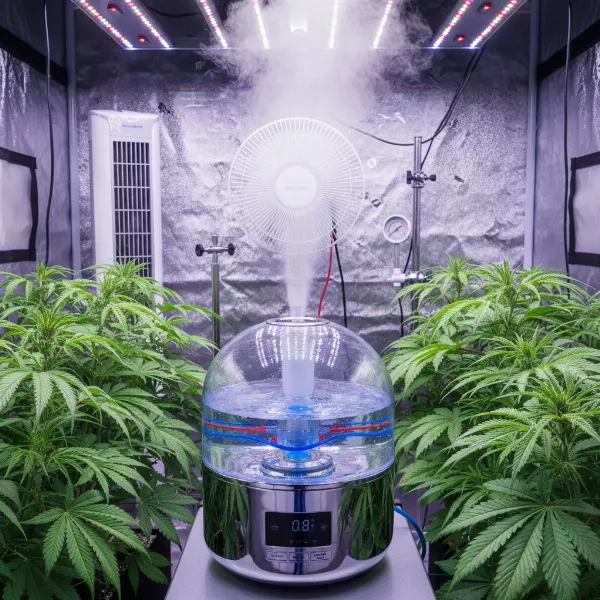 An ultrasonic humidifier releasing a fine cool mist inside a small grow tent with thriving green plants, optimized for internal environmental control
Evaporative Humidifiers: Natural & Filtered
Evaporative humidifiers work by drawing water from a reservoir into a wicking filter. A fan then blows air through this wet filter, causing the water to evaporate naturally into the air as an invisible vapor.
A key advantage of evaporative models is their self-regulating nature; as the humidity in the room increases, the rate of evaporation naturally slows down, reducing the risk of over-humidification. They also don’t produce white dust, even with hard water, as the minerals are left behind in the filter. The primary downsides are that they can be noisier due to the fan and require regular replacement of the wicking filters, which can be an ongoing cost. They may also struggle to reach very high humidity levels needed for some mushroom species.
Warm Mist Humidifiers: Generally Not Recommended
While some humidifiers offer a warm mist option, these are generally not ideal for grow tents or mushroom cultivation. The warmth can increase the ambient temperature, potentially creating unfavorable conditions or encouraging unwanted microbial growth. Cool mist is almost universally preferred for these applications.
Duct-Mounted / Industrial Humidifiers: For Large Scale
For larger commercial grow rooms or mushroom farms, industrial-grade or duct-mounted humidifiers are often employed. These systems are designed for massive output and can be integrated directly into a ventilation system, offering whole-room climate control. Brands like House of Hydro are known for their powerful ultrasonic foggers that can be adapted for large-scale operations, often built into custom reservoirs.
Comparative Overview of Humidifier Types
| Feature | Ultrasonic Humidifier | Evaporative Humidifier | Warm Mist Humidifier (General Use) |
|---|---|---|---|
| Mist Type | Cool Mist (visible) | Cool Mist (invisible) | Warm Mist (visible) |
| Noise Level | Very Quiet | Can be noisy (fan) | Quiet |
| Energy Usage | High efficiency | Medium efficiency | High (heating element) |
| White Dust | Yes (with hard water) | No | No |
| Filter Needs | No (but water filter helps) | Yes (wick filter) | No |
| Maintenance | Regular cleaning, descaling | Regular filter changes, cleaning | Regular cleaning |
| Precision Control | High | Self-regulating (less precise) | Medium |
| Cost | Medium to High | Low to Medium | Low to Medium |
| Best for | Grow tents, mushroom fruiting chambers, precise control | Small grow tents, general room humidification | Relief from cold/flu symptoms, smaller rooms |
Your Essential Buying Guide for Grow Tent and Mushroom Humidifiers
Selecting the best humidifier requires thoughtful consideration of your specific cultivation environment and goals. Here’s what to look for:
1. Capacity and Runtime: Match Your Space
The size of your grow tent or mushroom fruiting chamber dictates the humidifier’s required capacity. An undersized unit will constantly run, struggle to reach target humidity, and demand frequent refills, while an oversized one can lead to excessive condensation and mold.
- Small Grow Tents (2’x2′ to 3’x3′): 1-3 liter capacity, 1-2 gallons/day output.
- Medium Grow Tents (4’x4′ to 5’x5′): 4-6 liter capacity, 3-6 gallons/day output.
- Large Grow Tents (8’x8’+) or Mushroom Rooms: 8+ liter capacity, 6+ gallons/day output.
- Mushroom Fruiting Chambers: Often require higher humidity (85-95% RH), so a powerful ultrasonic unit with a large reservoir (2L+ for small chambers, larger for Martha tents) is crucial for consistent output.
Aim for a capacity that allows at least 24-48 hours between refills to maintain stable conditions and reduce manual intervention.
2. Humidity Control Features: Automation is Key
The ability to precisely control humidity is paramount. Look for humidifiers with:
- Adjustable Humidity Settings: (e.g., 35%-95% RH).
- Built-in Hygrometer/Humidistat: Essential for monitoring current conditions.
- External Sensor Probe: Provides more accurate readings by being placed at plant canopy level, away from the humidifier’s direct output.
- VPD (Vapor Pressure Deficit) Control: Advanced models, like those from AC Infinity, can automatically adjust humidity based on temperature, optimizing plant transpiration for each growth stage.
- Dial ON Switch: For automation, humidifiers with a physical dial (rather than a push button) are critical. This allows them to power on automatically when connected to an external humidistat or smart plug.
- Smart Features & App Integration: Features like programmable schedules, remote monitoring, and compatibility with environmental controllers (e.g., AC Infinity’s UIS™ system) can greatly enhance convenience and precision.
3. Noise Level: A Matter of Comfort
Ultrasonic humidifiers are generally the quietest, often operating below 35dB, which is akin to a whisper. If your grow tent is in a living space, a low-noise unit is a must. Evaporative models, with their internal fans, can be noticeably louder.
4. Ease of Maintenance: Cleanliness is Next to Grow-liness
Regular cleaning is non-negotiable to prevent the buildup of mold, bacteria, and mineral scale, which can harm your plants and equipment.
- Top-Fill Design: Simplifies refilling and cleaning significantly.
- Large Openings/Removable Tanks: Makes scrubbing and disinfecting easier.
- Auto Shut-off: A safety feature that turns the unit off when the water tank is empty, preventing damage.
5. Mist Distribution and Hoses: Even Coverage
Ensure the humidifier can effectively distribute mist throughout your entire grow space.
- Adjustable/Rotating Nozzles: Allows you to direct the mist.
- Extendable Hoses/Ducting Compatibility: For larger tents or mushroom fruiting chambers (like “Martha tents”), the ability to attach a hose (e.g., a washing machine drain hose) to pipe the mist into the enclosure is highly beneficial. This also keeps the electrical components outside the high-humidity environment, enhancing safety and longevity.
Top Picks: Humidifiers That Deliver
Based on extensive testing and user feedback, here are some leading humidifiers and controllers suitable for grow tents and mushroom cultivation:
For Grow Tents:
- VIVOSUN AeroStream H19 (Best Overall for Serious Growers): With a massive 19L capacity and smart app integration, this unit offers reliable humidity control for days without constant refilling. Its external sensor probe ensures accurate readings and quiet operation.
- AC Infinity CLOUDFORGE T3/T7 (Best Value/Large Capacity with Precision Control): AC Infinity humidifiers, like the T3 (4.5L) and T7 (15L), are built for grow tents, featuring VPD controls, 10-level precision vaporizers, and extendable targeting hoses. They integrate seamlessly with AC Infinity’s UIS™ controllers for advanced automation. The T3 is noted for bringing professional-grade control to home growers, while the T7 scales up for larger setups.
- Taotronics 4L Cool Mist Humidifier (Best Budget Option): An affordable ultrasonic humidifier with a 4-liter tank, top-fill design, and 360-degree nozzle, suitable for small to medium-sized tents.
- Inkbird IHC-200 Humidity Controller (Essential Automation): While not a humidifier itself, pairing this digital humidistat with any suitable humidifier transforms it into an automated “set and forget” system. It precisely monitors and controls humidity by turning the humidifier on and off within your desired range.
For Mushroom Cultivation:
- Vicks Cool Mist v600 (Reliable & Large Reservoir): This ultrasonic humidifier features a 4.1L tank, offering up to 30 hours of runtime. Its dial-on switch allows for easy automation with smart plugs, and the rotating nozzle can be removed to fit a hose for ducting mist into a fruiting chamber.
- HemingWeigh Ultrasonic Humidifier / AquaOasis Cool Mist Humidifier (Good Entry-Level Ultrasonics): These 2-2.2L units are good for beginners. They have dial-on switches for automation and offer sufficient mist for smaller mushroom grows.
- House of Hydro Ultrasonic Foggers (Commercial/DIY Large Scale): For larger mushroom rooms, multi-disc ultrasonic foggers from brands like House of Hydro, often combined with a large container and fan, provide significant mist output.
Cleaning and Maintenance: Protecting Your Investment and Your Crop
Regular maintenance of your humidifier is not just about extending its lifespan; it’s crucial for preventing the growth of harmful bacteria, mold, and algae that could be aerosolized into your grow tent or mushroom chamber.
Weekly Cleaning Routine:
- Empty and Rinse: Completely empty the water tank and wipe it down with a soft cloth.
- Vinegar Solution: Fill the base and tank with a 1:1 solution of white vinegar and water. Let it sit for 30 minutes to an hour to dissolve mineral buildup and kill mild bacteria.
- Scrub Gently: Use a soft brush (like an old toothbrush) or cloth to gently scrub any remaining film or scale from the tank, base, and transducer plate (for ultrasonic models).
- Rinse Thoroughly: Rinse all components thoroughly with clean water until no vinegar smell remains.
Monthly Deep Clean:
Perform a deep clean using a weak hydrogen peroxide solution (e.g., 1 part 3% hydrogen peroxide to 10 parts water) to disinfect and kill any persistent microbes. Let it sit for 30 minutes, then rinse extremely well multiple times with clean water to ensure no residues are left behind, as chemicals can harm your plants or mushrooms.
Pro-Tip: Use Distilled or RO Water
The single most effective way to reduce maintenance, prevent white dust from ultrasonic humidifiers, and prolong the life of your unit is to use distilled or reverse osmosis (RO) water. This eliminates minerals at the source, vastly reducing scale buildup and the need for frequent descaling.
Conclusion: Cultivating Success Through Climate Control
Mastering humidity control with the right humidifier is a cornerstone of successful indoor gardening, whether you’re tending to plants in a grow tent or cultivating gourmet mushrooms. It directly influences plant health, mushroom development, and the overall quality and abundance of your harvests. By understanding the critical environmental needs of your crops, selecting an appropriate humidifier, and maintaining it diligently, you lay the groundwork for a thriving and productive indoor ecosystem.
The best humidifier for your specific needs will offer reliable output, precise control, and manageable maintenance. Investing in a quality unit, especially one paired with an automated controller, means less guesswork and more consistent results, allowing your plants and mushrooms to flourish without constant intervention. Take the time to choose wisely, and your efforts will be rewarded with vigorous growth and bountiful yields.
What steps will you take today to optimize the humidity in your grow space and elevate your cultivation journey?
Frequently Asked Questions
What are the ideal humidity levels for plants in a grow tent?
Optimal humidity varies by growth stage: seedlings and clones require 70-80% RH, vegetative plants thrive at 50-70% RH, and flowering plants prefer 40-50% RH to prevent issues like mold. Always research the specific needs of your plant varieties.
How much humidity do mushrooms need to grow optimally?
Most mushroom species thrive in relative humidity levels between 85% and 95% during their fruiting stage. Lower humidity can lead to dehydration and stalled growth, while excessively high humidity can encourage contaminants.
How can I prevent white dust from my ultrasonic humidifier?
White dust is caused by minerals in hard tap water being aerosolized. The most effective solution is to use distilled or reverse osmosis (RO) water. Regular cleaning with a vinegar solution also helps manage any residual buildup.
What size humidifier do I need for a 4×4 grow tent?
For a standard 4×4 grow tent, a humidifier with a 4-6 liter capacity and an output of 2-4 gallons per day is typically ideal. This ensures sufficient moisture for the 64 cubic feet of space throughout most growth stages.
Can I run both a humidifier and dehumidifier in the same grow tent?
Yes, this is a common strategy for professional climate control, especially when using an environmental controller like the Inkbird IHC-200. This setup allows you to precisely maintain a target humidity range by activating the humidifier when levels are too low and the dehumidifier when they are too high, preventing them from working against each other.
Why is my humidity still low even with the humidifier running on max?
If your humidity remains low, your humidifier may be undersized for the space, or your exhaust fan might be removing moist air too quickly. Try reducing your exhaust fan speed, or consider upgrading to a humidifier with a higher output capacity. Ensure all tent vents are properly sealed to prevent air leaks.