Stepping into a home with perfectly balanced humidity is a subtle luxury, warding off dry skin, irritated throats, and static shocks. Humidifiers offer a vital solution to the pervasive problem of dry indoor air, yet a common question lingers in many homeowners’ minds: what is the actual cost of keeping this essential device running around the clock? Understanding the financial implications of continuous humidifier use—from electricity bills to maintenance—is key to ensuring comfort without breaking the bank. This comprehensive guide will illuminate the various expenses involved, helping you optimize your humidifier’s operation and maximize its benefits.
The Unseen Electricity Bill: How Humidifiers Consume Power
The primary driver of your humidifier’s running cost is its electricity consumption. Humidifiers convert electrical energy into moisture, with the amount of power consumed varying significantly by type and model. To truly grasp the cost, it’s essential to understand how wattage translates into your monthly utility bill.
A humidifier’s power usage is typically measured in watts (W). To calculate the cost, you convert watts to kilowatts (kW) by dividing by 1000, then multiply by the hours of operation and your local electricity rate per kilowatt-hour (kWh). For instance, a typical humidifier might use between 20 to 50 watts per hour. Running such a unit for 24 hours could cost less than $0.10 per day, but this figure can climb significantly depending on the humidifier type and your energy tariff. The average electricity rate in the US is around $0.16 per kWh.
“Understanding your humidifier’s wattage and local electricity rates is the first step to decoding its true operating cost. It’s a simple calculation that empowers homeowners to make informed energy decisions.” – Sarah Miller, Home Energy Efficiency Expert
Types of Humidifiers and Their Energy Footprint
Different humidifier technologies come with distinct energy demands. Knowing these differences can profoundly impact your running costs, especially when operating a unit 24/7.
Ultrasonic Humidifiers
|
Our Picks for the Best Humidifier in 2026
As an Amazon Associate I earn from qualifying purchases.
|
||
| Num | Product | Action |
|---|---|---|
| 1 | COO Humidifiers for Bedroom, 2L Tank for Large Room, 30 Hour Runtime, 28dB Quiet Cool Mist Humidifier for Home, Baby Nursery, Plants, Indoor, Office, Easy to Fill & Clean,Night Light and Auto Shut-off |

|
| 2 | Dreo Smart Humidifiers for Bedroom, Top Fill 4L Supersized Humidifier Large Room with 28 dB, 36H Runtime, Touch/APP/Voice Control, Nightlight, Cool Mist Humidifiers for Baby, Plants, Indoor, Black |
|
| 3 | DREO 6L Top Fill Humidifiers for Bedroom, 60H Runtime 28 dB Quiet Supersized Cool Mist Air Humidifiers for Large Room, Baby Nursery, Plant, Indoor, Night Light, Easy to Clean, Precise Humidity Control |
|
| 4 | LEVOIT Top Fill Humidifiers for Bedroom, 2.5L Tank for Large Room, Easy to Fill & Clean, 28dB Quiet Cool Mist Air Humidifier for Home Baby Nursery & Plants, Auto Shut-off for Safety, 25H |
|
| 5 | MegaWise Topfill 7-colour Night light humidifier for Kid bedroom with 3.5L Large Capacity, No leakage Design Fine Mist Output Auto Shutoff, Essential Oil Safe Tank |
|
| 6 | LEVOIT - Humidifiers for Bedroom - Quiet (3L Water Tank) - Cool Mist/Top Fill/Essential Oil Diffuser/25Watt - Home/Large Room - 360° Nozzle - Rapid Ultrasonic Humidification for Baby Nursery/Plant |
|
| 7 | DREO Humidifiers for Bedroom, 3L Top Fill 30H & 26dB Quiet Runtime for Large Room, Cool Mist Ultrasonic Humidifier with Humidity Sensor, Night Light for Home, Baby, Nursery, Plants, New Edition |
|
| 8 | Homvana Humidifiers for Bedroom Home, 3.6 L Cool Mist Top-Fill 34H Super Long Time, Quiet 23dB, Baby Humidifier, Oil Diffuser for Large Room, House, Plant, Nursery, Office, BPA FREE, Ultrasonic (Grey) |
|
| 9 | LEVOIT Humidifiers for Bedroom Large Room Home, (6L) Cool Mist Top Fill Essential Oil Diffuser for Baby & Plants, Smart App & Voice Control, Rapid Humidification & Auto Mode - Quiet Sleep Mode, Gray |
|
| 10 | Dreo Humidifiers for Bedroom, 4L Top Fill for Large Room, 36H Runtime, 28 dB Quiet Supersized Cool Mist Air Humidifier for Baby Nursery, Plants, Indoor, Night Light, Easy to Clean & Fill, White |
|
Ultrasonic humidifiers use high-frequency sound vibrations to create a fine, cool mist. They are renowned for their quiet operation and are generally among the most energy-efficient options, typically consuming less than 30 watts, with some models using as little as 10-35 watts. This low wattage makes them an attractive choice for continuous use in bedrooms or offices where noise and energy consumption are top concerns. Their filter-free design also minimizes some maintenance hassles.
Evaporative Humidifiers
Evaporative humidifiers work by drawing air through a wet wick filter with a fan, releasing moisture into the room. While they require a fan, they are still considered very energy-efficient, usually consuming between 15 to 50 watts of electricity. Some evaporative models are reported to use as little as 0.14 to 0.72 kWh over a 24-hour period. They offer a natural, self-regulating humidification process, as the air only absorbs as much moisture as it can hold. However, their reliance on wicks means regular filter cleaning or replacement.
Warm Mist Humidifiers (Vaporizers)
Warm mist humidifiers, also known as vaporizers, heat water to produce steam, which is then released into the air. This boiling process effectively kills germs and bacteria, providing a sterile mist, but it is also the most energy-intensive method. These units typically consume 150-300 watts, with some whole-house steam humidifiers potentially drawing over 1000 watts during operation. A specific vaporizer model can use between 3.6 to 7.2 kWh per 24 hours, depending on its power level. While effective, their higher electricity usage makes them more expensive to run continuously compared to cool mist alternatives.
Whole-House Humidifiers
Integrated into your home’s HVAC system, whole-house humidifiers provide moisture to the entire living space. These can be evaporative, bypass, fan-powered, or steam-based. While offering comprehensive coverage and often less frequent maintenance (compared to refilling portable units), their running costs vary significantly. Steam whole-house units, due to their boiling mechanism, tend to consume the most electricity among all types.
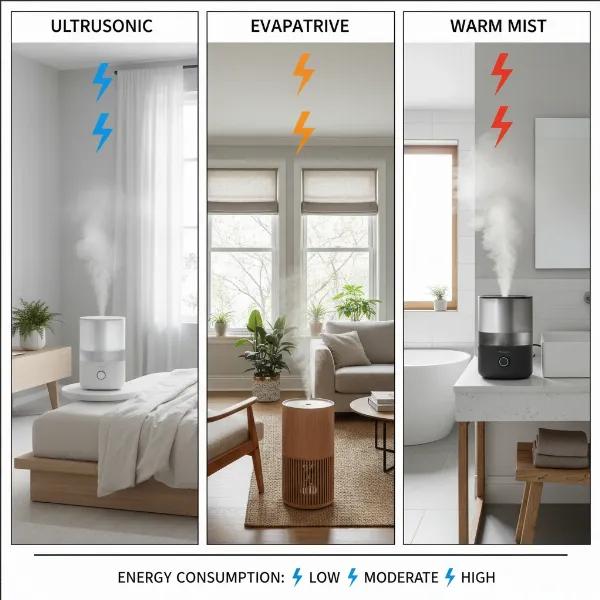 Comparison of various humidifier types and their energy consumption in a home setting
Comparison of Common Humidifier Types
To put the energy consumption into perspective, here’s a brief comparison:
| Humidifier Type | Average Wattage (approx.) | Daily kWh (24/7) (approx.) | Estimated Daily Cost (@$0.16/kWh) | Noise Level | Maintenance Needs |
|---|---|---|---|---|---|
| Ultrasonic | 10-35 W | 0.24 – 0.84 kWh | $0.04 – $0.13 | Very Quiet | Regular cleaning; no filters |
| Evaporative | 15-50 W | 0.36 – 1.2 kWh | $0.06 – $0.19 | Moderate | Filter replacement; cleaning |
| Warm Mist | 150-300 W | 3.6 – 7.2 kWh | $0.58 – $1.15 | Quiet | Descaling; cleaning |
| Whole-House (Steam) | 1000+ W | 24+ kWh | $3.84+ | Quiet | Descaling; professional service |
Note: Costs are estimates and depend heavily on specific model efficiency, local electricity rates, and actual usage patterns.
Beyond the Plug: Hidden Costs of Humidifier Ownership
While electricity is the most obvious expense, other factors contribute to the long-term cost of running a humidifier, especially 24/7.
Water Consumption and Cost
Humidifiers, by their very nature, require water. Running a unit continuously means a consistent draw on your water supply. While generally minimal compared to electricity, water costs can accumulate, particularly for high-capacity units that might consume 1-3 gallons daily during peak seasons. This could potentially add $50-$150 annually to water bills in areas with higher municipal water rates. Using distilled water, often recommended for ultrasonic humidifiers to prevent “white dust,” adds another layer of expense.
Maintenance and Replacement Parts
Regular maintenance is crucial for optimal performance and energy efficiency. For evaporative humidifiers, filters need routine cleaning or replacement, which is an ongoing expense. For warm mist humidifiers, mineral buildup (limescale) from boiling water can accumulate, requiring frequent descaling and cleaning to maintain efficiency. Neglecting maintenance can lead to reduced performance, higher energy consumption, and eventually, the need for costly repairs or early replacement. Some steam humidifiers use replaceable boiling cylinders, which present an ongoing operational cost.
Factors That Drive Your Humidifier’s Running Costs
Several variables influence how much you’ll spend to keep your humidifier running.
Unit Type and Efficiency
As discussed, warm mist humidifiers are significantly more energy-hungry than ultrasonic or evaporative models. Choosing an ENERGY STAR-rated model can lead to substantial savings, as these units meet strict energy performance standards.
Electricity Rates
The cost of electricity per kWh varies dramatically by geographic location and even time of day. Areas with higher utility rates will naturally see higher running costs for the same humidifier.
Room Size and Environmental Conditions
A small personal humidifier designed for a single room will cost less to run than a large console unit intended for an entire floor, or a whole-house system. Furthermore, environmental factors like the initial dryness of the air, outdoor temperature, and desired humidity level will dictate how hard and long your humidifier needs to work. A home in an arid climate will require more consistent humidification than one in a naturally more humid region.
Usage Patterns and Humidistat Use
Running a humidifier 24/7 will inevitably incur higher costs than using it intermittently. However, many modern humidifiers come with a built-in humidistat, which automatically measures the room’s humidity and turns the unit on or off to maintain a set level. This feature is invaluable for preventing over-humidification and saving energy by ensuring the humidifier only runs when necessary. Manual humidifiers without this feature can lead to unnecessary energy consumption if not monitored closely.
Home Insulation and Airtightness
A well-insulated and airtight home will retain humidity more effectively, reducing the need for continuous humidifier operation. Conversely, a drafty home with poor insulation will lose moisture quickly, forcing the humidifier to work harder and longer, thus increasing costs.
Smart Strategies to Reduce Your Humidifier’s Operating Expenses
You can enjoy the benefits of balanced indoor humidity without excessive costs by implementing a few smart strategies.
Choose an Energy-Efficient Model
When purchasing, prioritize ENERGY STAR certified humidifiers, especially ultrasonic or evaporative types, known for their lower wattage consumption.
Utilize Humidistats and Timers
Always use a humidifier with an integrated humidistat or an external one to automatically maintain optimal humidity levels (ideally between 40-60%). If your unit lacks this, use a timer to schedule operation during the driest parts of the day or when you are present.
Proper Sizing for Your Space
Match the humidifier’s capacity to the size of the room it’s intended for. An undersized unit will struggle and run constantly without achieving desired results, while an oversized one can lead to over-humidification and wasted energy.
Regular Cleaning and Maintenance
Consistent cleaning prevents mineral buildup and microbial growth, ensuring your humidifier operates at peak efficiency. For evaporative models, replace wicks and filters according to manufacturer guidelines. For warm mist units, descaling is crucial to prevent heating element inefficiency. This not only saves energy but also prolongs the life of your device.
Seal Drafts and Close Windows
Preventing moisture loss from your home is a simple yet effective way to reduce your humidifier’s workload. Close windows and doors, and seal any obvious drafts to keep the humidified air inside.
Maximizing Value: Is Running a Humidifier 24/7 Worth It?
Given the costs, the question remains: is continuous humidifier operation a worthwhile investment? For many, the answer is a resounding yes.
The benefits extend beyond mere comfort. Maintaining optimal indoor humidity can alleviate dry skin, chapped lips, and irritated nasal passages. It can reduce the severity of allergy and asthma symptoms, making breathing easier. Interestingly, a properly humidified home can also feel warmer, potentially allowing you to lower your thermostat and save on heating costs. Beyond personal well-being, humidifiers protect wooden furniture, flooring, and musical instruments from cracking and warping in excessively dry environments.
While running a humidifier 24/7 incurs a cost, smart choices in unit type, diligent maintenance, and strategic use of humidistats can keep expenses manageable while preserving the health of your family and home.
Conclusion
The Cost Of Running A Humidifier 24/7 is a multi-faceted equation, influenced by the unit type, your local electricity rates, water usage, and consistent maintenance. While a typical portable humidifier might add a relatively small amount to your daily utility expenses, steam-based and larger whole-house systems will naturally demand a more significant investment. By opting for energy-efficient models, utilizing smart features like humidistats, and committing to a regular cleaning schedule, you can effectively manage these costs. The comfort, health benefits, and protection of your home’s furnishings often far outweigh the operational expenses, making a humidifier a valuable addition to your indoor environment. Are you ready to optimize your humidifier’s performance and enjoy perfectly balanced humidity?
Frequently Asked Questions
What type of humidifier is the most energy-efficient for continuous use?
Ultrasonic and evaporative humidifiers are generally the most energy-efficient for continuous use. They consume significantly less power (10-50 watts) compared to warm mist or steam humidifiers, resulting in lower daily operating costs.
How much does a humidifier add to a typical electricity bill per month?
For a typical energy-efficient portable humidifier running intermittently, the added cost is often less than $10 per month. However, a less efficient model running 24/7 could add $30 or more, depending on wattage and electricity rates.
Do humidifiers use a lot of water?
Humidifiers do use water, typically 1 to 3 gallons per day for larger units when running constantly. While water costs are usually minimal, they can accumulate over time, especially if using distilled water or living in an area with high water rates.
Can a humidifier help save on heating costs?
Yes, a humidifier can indirectly help save on heating costs. Properly humidified air feels warmer than dry air at the same temperature, allowing you to potentially lower your thermostat setting and still feel comfortable, thus reducing your heating energy consumption.
How often should I clean my humidifier to keep costs down?
Regular cleaning, ideally every 1-3 days for portable units and weekly for others, is crucial. This prevents mineral buildup and bacterial growth, ensuring the unit runs efficiently and doesn’t consume excess energy due to clogs or reduced performance.